Description
“These Statements Have Not Been Evaluated By The Food And Drug Administration.
This Product Is Not Intended To Diagnose, Treat, Cure Or Prevent Any Disease.”
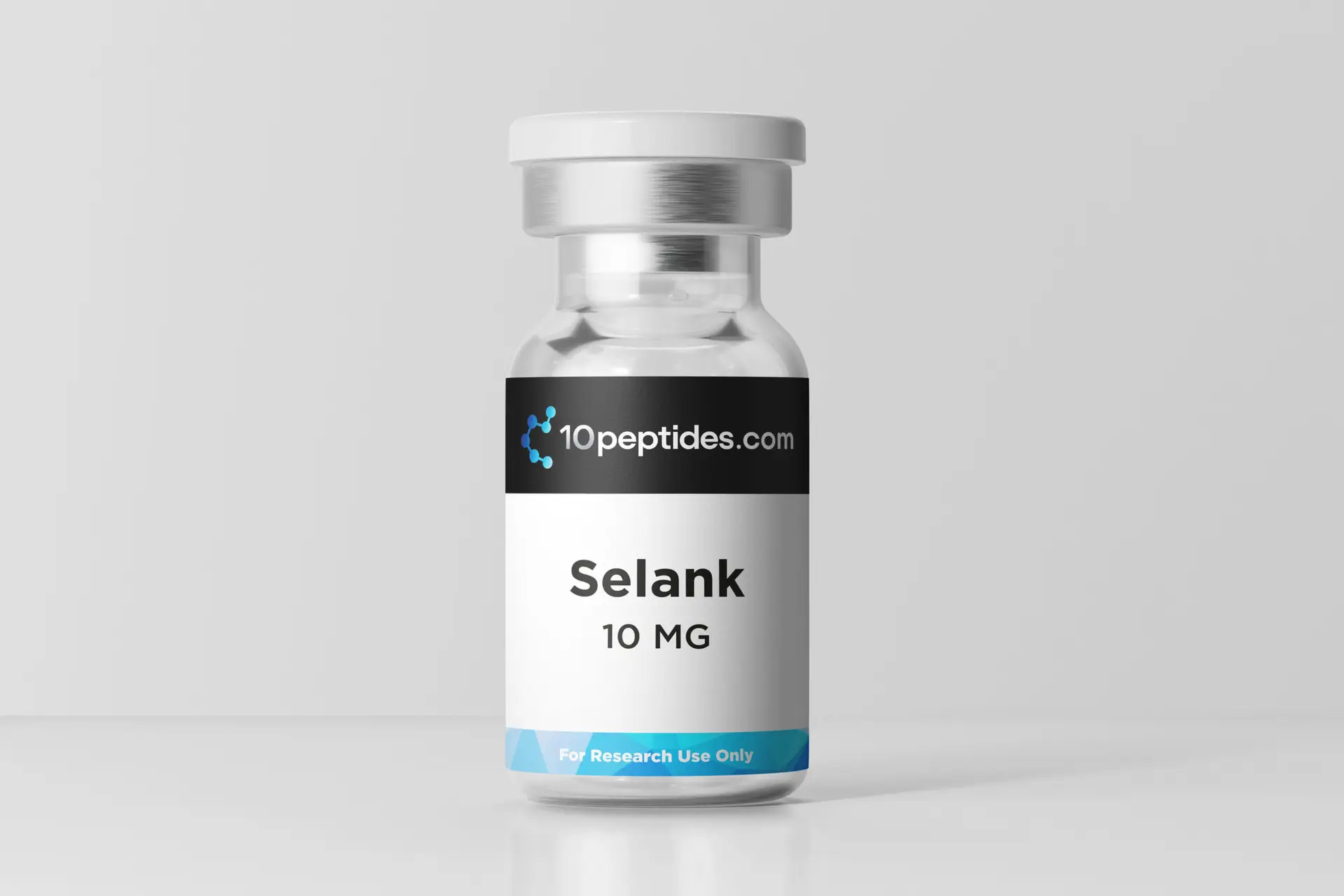
Selank
Selank is a high-purity synthetic heptapeptide derived from the natural immunomodulatory molecule tuftsin. It is widely used in molecular neuroscience and psychoneuroimmunology research to investigate GABAergic signaling, serotonin pathways, stress regulation, and immune-neural interactions.
Its stability, purity, and predictable activity make it a reliable reagent for academic laboratories and peptide research prog
Selank (Synthetic Tuftsin Analog): Neuropeptide & Neuroimmune Research Peptide
Product Specifications
- Sequence: Thr-Lys-Pro-Arg-Pro-Gly-Pro Untitled document (11)
- Molecular Weight: ~863 Da
- Purity: ≥99% (HPLC verified) Untitled document (11)
- Solubility: Sterile water or PBS
- Storage: −20°C, protected from light and moisture
- Use: For Research Use Only. Not for human or veterinary use
Description
Selank is a synthetic heptapeptide engineered from the naturally occurring immunomodulatory molecule tuftsin, a fragment derived from the IgG heavy chain. As a research compound, it occupies a unique position in modern neuroscience because it sits at the intersection of neurotransmitter regulation, gene-expression dynamics, and immune-system signaling, making it one of the most versatile neuropeptides available to laboratories.
Structurally simple, just seven amino acids, yet functionally far-reaching, Selank offers researchers a consistent and highly reproducible model for studying neurochemical balance, stress adaptation, and psychoneuroimmunology. Its high purity (≥99%, HPLC verified) and stability make it well-suited for controlled in-vitro and in-vivo laboratory systems.
What distinguishes Selank from many classical neuropeptides is its dual-domain mechanism: it simultaneously affects both neural and immune pathways. In neurobiological systems, it modulates GABAergic transmission, stabilizing inhibitory tone and altering receptor response patterns. This is complemented by its influence on serotonergic circuits, where studies have documented shifts in gene transcription associated with serotonin synthesis and receptor regulation. Such dual modulation gives this peptide an important role in research on emotional regulation, inhibitory control, and behavioral neuroadaptation, areas where both neurotransmitters operate in synchrony.
Selank also exerts measurable effects on neurotrophic factors such as BDNF, along with transcription markers that relate to synaptic plasticity and cognitive processing. These gene-level shifts allow researchers to examine how small peptides can modulate the nervous system without directly interacting with classical receptor sites, an emerging trend in peptide neurobiology.
On the immune side, Selank is equally intriguing. Multiple studies have shown that the peptide modulates key cytokines including IL-6, IL-10, and TNF-α, placing it at the center of research into the stress–immune axis. This positions it as a valuable tool for psychoneuroimmunology, enabling investigations into how psychological stress, infection, or inflammation influences neural function. In many experiments, it provides a bridge between immune signaling and neurochemical adaptation, allowing researchers to observe the two systems in tandem.
Comparison: Selank vs Semax
Although Selank and Semax are often grouped as “regulatory neuropeptides,” they originate from entirely different biological families and therefore behave differently in research settings. It’s a tuftsin analog, inherited from immune-system signaling, while Semax is an ACTH(4-10) analog, originating from endocrine stress pathways.
This peptide primarily influences GABA/serotonin balance and cytokine regulation, whereas Semax focuses more on BDNF expression, neuroprotection, and metabolic resilience. Both inhibit certain enkephalin-degrading enzymes, but through distinct structural domains. The two peptides complement each other but are not interchangeable.