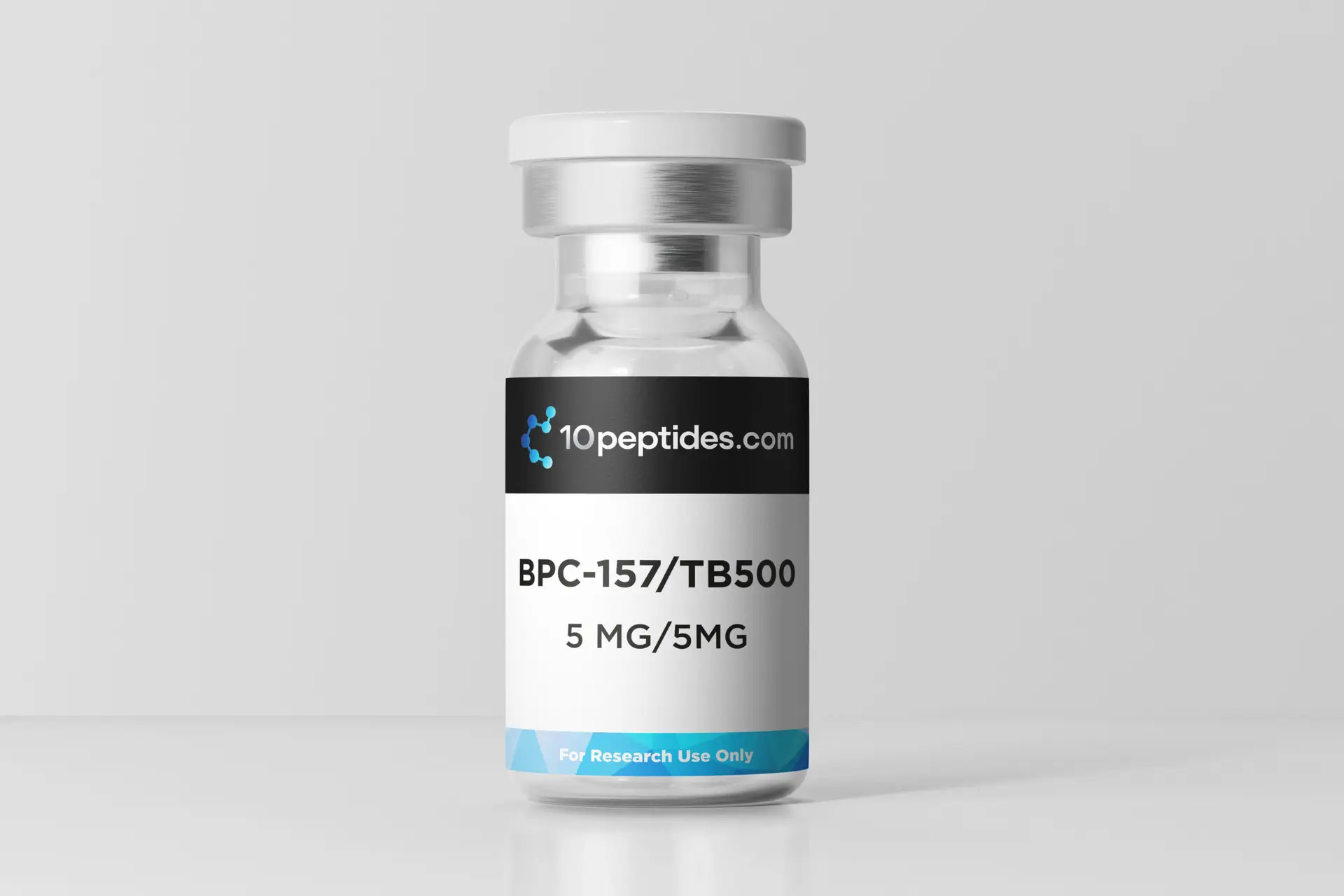
Description
“These Statements Have Not Been Evaluated By The Food And Drug Administration.
This Product Is Not Intended To Diagnose, Treat, Cure Or Prevent Any Disease.”
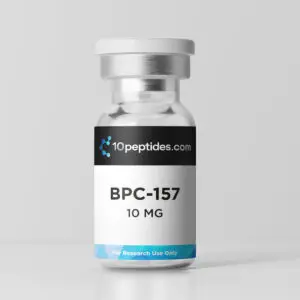
BPC157 TB500 Research Blend Lyophilized 10mg
TECHNICAL SPECIFICATIONS ( Research Blend)
- Active Components : Pentadecapeptide BPC 157 + Thymosin Beta-4 Fragment
- CAS Registry Nos. : 137525-51-0 (BPC) & 885340-08-9 (TB500)
- Target Mechanism : Angiogenesis (VEGF/NO) + Actin Cytoskeletal Migration
- Molecular Weight : 1,419.56 Da (BPC) / 889.02 Da (TB500)
- Formulas : C₆₂H₉₈N₁₆O₂₂ (BPC) / C₃₈H₆₈N₁₀O₁₄ (TB500)
- Purity Grade : ≥99% (HPLC Verified Precision Blend)
- Storage (Powder) : Stable at -20°C (Keep Desiccated)
- Sequence (BPC) : Gly-Glu-Pro-Pro-Pro-Gly-Lys-Pro-Ala-Asp-Asp-Ala-Gly-Leu-Val
Disclaimer : For Research Use Only (RUO). Not for human use.
Product Overview
BPC157 TB500 is a Certified Reference Material (CRM) comprising a Co-Lyophilized Reagent Matrix of Pentadecapeptide (CAS 137525-51-0) and Thymosin Fragment (CAS 885340-08-9). Supplied as a Single Analytical, this reagent is engineered strictly for instrument calibration, chromatography (HPLC) profiling, and chemical stability assays.
The proprietary co-lyophilization process ensures a verified 1:1 Molar Ratio, providing a stable baseline for non-biological laboratory research and solvent interaction studies.
Chemical Identity & Mechanism ( BPC157 TB500 )
1. BPC 157: The “Angiogenic Primer.”
BPC 157 (Pentadecapeptide) acts by modulating the nitric oxide synthase (NOS) pathway.
Action : It stimulates the VEGF/VEGFR2-Akt-eNOS signaling axis. This “primes” the tissue for repair by enhancing blood flow and up-regulating early growth response gene-1 (EGR-1).
2. TB500: The “Structural Mobilizer.”
TB500 is a fragment of Thymosin Beta-4. Its primary role is Actin Sequestration.
Action : By regulating actin polymerization (G-actin to F-actin ratio), TB500 allows cells to change shape and physically migrate to the site of damage. It provides the “structural support” for the repair signaled by BPC 157.
3. The Synergistic Effect
Recent 2026 reviews suggest these mechanisms are complementary. BPC 157 enhances the survival of fibroblasts under stress, while TB500 accelerates their migration, theoretically speeding up the remodeling of the extracellular matrix (ECM).
Chemical Structures ( BPC157 TB500 )
Chemical Structure of BPC 157 (Pentadecapeptide)

2D Chemical Structure of BPC 157 (Pentadecapeptide), CAS 137525-51-0, Research Grade Peptide for Angiogenesis Study
Molecular Structure of BPC 157. A synthetic 15-amino acid peptide derived from human gastric juice (Sequence: Gly-Glu-Pro-Pro-Pro…). Source: PubChem CID 9941957.
Chemical Structure of TB500 Fragment (Ac-LKKTETQ)

2D Chemical Structure of TB500 Fragment (Ac-LKKTETQ), CAS 885340-08-9, Thymosin Beta-4 Active Fragment for Actin Regulation
Molecular Structure of TB500 (Thymosin Beta-4 Fragment). The active 7-amino acid sequence (Ac-LKKTETQ) is responsible for cell migration. Source: PubChem CID 16132341.
Regulatory Status : Research Use Only (RUO). Not for human consumption, diagnostic, or clinical use.
REGULATORY & COMPLIANCE STATEMENT
Classification : Research Use Only (RUO). Not for human consumption, cosmetic, diagnostic, or clinical use.
FDA Warning: BPC 157 is classified as a Category 2 Bulk Drug Substance. It is not approved for the treatment of any disease (injury, inflammation) in humans.
WADA Warning: Both BPC157 TB500 are banned by the World Anti-Doping Agency (WADA) under “Peptide Hormones, Growth Factors, Related Substances, and Mimetics.” Athletes are strictly prohibited from using these compounds.
Handling : Wear nitrile gloves. Refer to the Safety Data Sheet (SDS) for CAS 137525-51-0 and 885340-08-9.
Frequently Asked Questions
Q1: Why combine BPC157 TB500 in a single blend?
A: Synergy. Research indicates they target different rate-limiting steps of tissue repair. BPC 157 modulates “signaling” (NO/VEGF) to reduce inflammation and increase blood flow, while TB500 modulates “mechanics” (actin cytoskeleton) to enable cell migration. Combining them targets both the biochemical and structural aspects of recovery.
Q2: Is TB500 the same as Thymosin Beta-4?
A: No, but they are related. Thymosin Beta-4 is a 43-amino acid protein. TB500 is a synthetic fragment (usually amino acids 17-23, sequence Ac-LKKTETQ) that contains the essential actin-binding domain. Our blend uses this active fragment to ensure targeted research outcomes without the bulk of the full protein.
Q3: What are the primary safety and handling precautions?
A: Standard Laboratory Protocols (GLP). As this reagent comprises high-purity organic compounds, strict Personal Protective Equipment (PPE) protocols must be observed. Researchers should handle the lyophilized cake and reconstituted solution within a controlled environment (e.g., laminar flow hood) to prevent accidental inhalation or dermal contact. This material is strictly for non-biological, analytical use only.
Q4: How should this blend be reconstituted for research?
A: Standard USP Bacteriostatic Water is the preferred vehicle. BPC 157 is highly stable in gastric juice (acidic) and water, while TB500 is water-soluble. Reconstitute slowly down the side of the vial and do not shake, as mechanical stress can damage the peptide structure.