“These Statements Have Not Been Evaluated By The Food And Drug Administration.
This Product Is Not Intended To Diagnose, Treat, Cure Or Prevent Any Disease.”
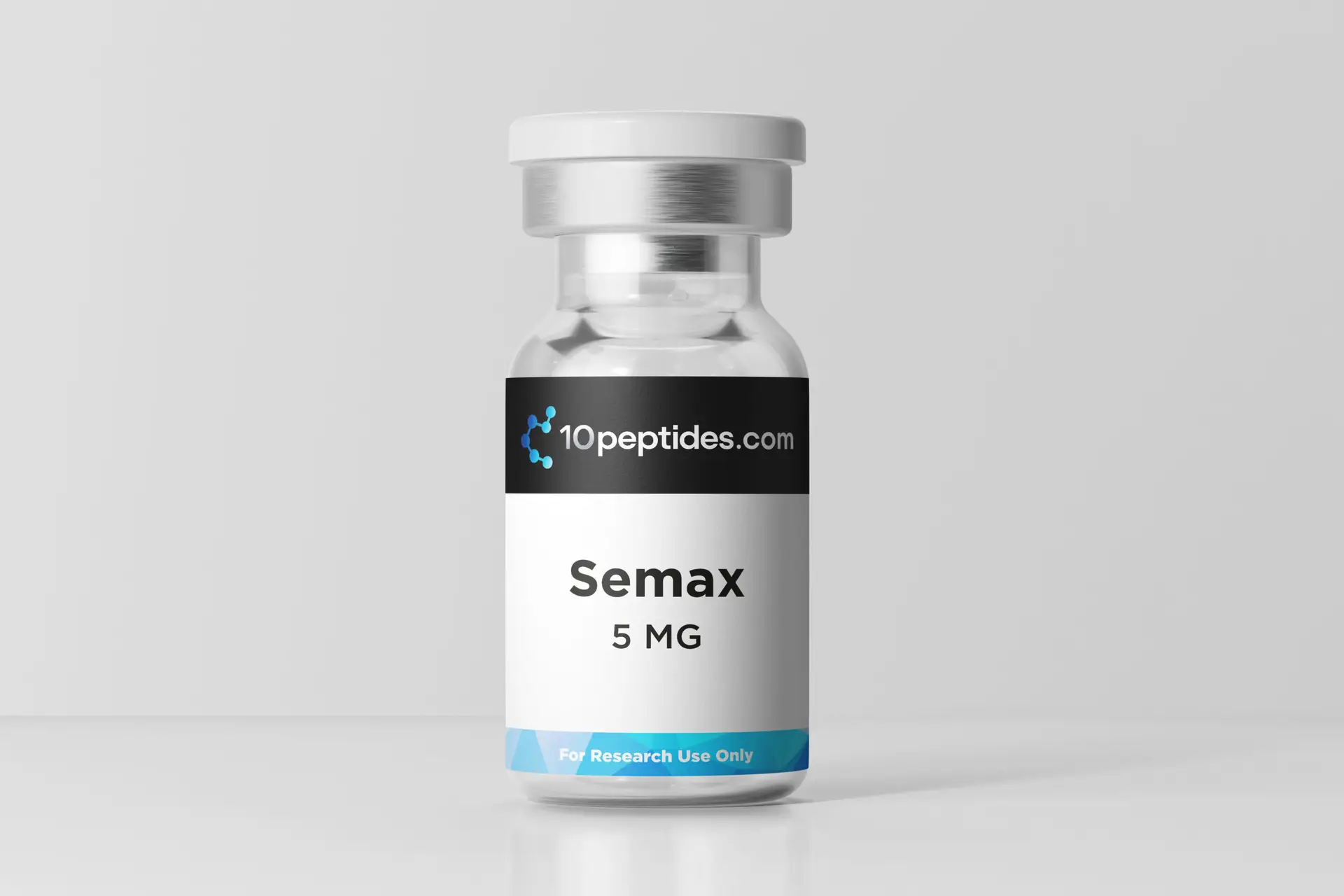
Semax (ACTH 4–10 analog): Neurotrophic &Neuroprotective Research Peptide
Product Specifications
- Formula: Synthetic heptapeptide (Met-Glu-His-Phe-Pro-Gly-Pro)
- Molecular Weight: ~809 Da
- Purity: ≥99% (HPLC verified)
- Solubility: Dissolves in sterile water or PBS
- Storage: −20°C, protected from light and moisture
- Use: For Research Use Only. Not for human or veterinary use.
Description
Semax identity, design, and research scope
Semax peptide (Met-Glu-His-Phe-Pro-Gly-Pro) is a synthetic heptapeptide derived from the ACTH(4–10) sequence and designed specifically for neuromolecular research. Unlike full-length ACTH or adrenal-stimulating peptides, this peptide does not trigger cortisol release or systemic hormonal activity. This characteristic makes it useful for laboratory studies focused solely on neurobiology, gene regulation, and oxidative stress pathways.
Delivery properties and core neurobiological actions
Because of its small molecular size and proteolytic stability, Semax peptide can reach central nervous system tissues efficiently in intranasal research models. Moreover, once inside neural pathways, it interacts with networks that control neuron survival, synaptic repair, and antioxidant defense.
Neurotrophic and transcriptomic mechanisms
Importantly, over the past decade, scientists have paid particular attention to Semax’s potential to influence BDNF and NGF, two proteins strongly associated with synaptic plasticity and neural regeneration. Consequently, increased expression of these proteins has been reported in multiple ischemia-reperfusion and oxidative stress models, thereby allowing deeper exploration of neurotrophic-driven repair mechanisms (Dergunova et al., 2021; Koroleva & Myasoedov, 2018).
So it has gained additional interest in the field of pharmacotranscriptomics—the study of how peptides affect gene expression. RNA-Seq and microarray analysis show that Semax peptide can alter the transcription of hundreds of genes related to neuronal metabolism, mitochondrial signaling, vascular response, cytokine balance, and synaptic structure (Filippenkov et al., 2020; Dergunova et al., 2023). This makes Semax peptide not just a symptomatic model compound, but a valuable tool for understanding the genomic architecture of neuroprotection.
Experimental models and research applications
Moreover, in ischemia research models, including middle cerebral artery occlusion (MCAO), Semax peptide has been associated with improved antioxidant enzyme activity, reduced inflammatory signaling, and preservation of microvascular function. Additionally, proteomic work supports these findings, showing regulation of oxidative stress-responsive proteins and cytoskeletal elements linked to neuronal survival (Sudarkina et al., 2021; Vyunova et al., 2016). Consequently, this peptide has become a frequent choice in stroke-related laboratory studies.
Beyond ischemia models, Semax peptide has also appeared in experiments involving oxidative injury, retinal ganglion cell protection, and dopaminergic neuron signaling. This range of applications allows researchers to compare it with other neuroactive peptides—including Selank, P21, and synthetic BDNF mimetics—to understand overlapping pathways of neuroplasticity and transcriptional control.
Overall, Semax peptide provides a consistent, high-purity research peptide for studying neurotrophic regulation, ischemic response, oxidative stress, and gene-level mechanisms of neural adaptation. Its stability, solubility, and well-documented molecular pathways make it a practical and reliable tool in experimental neuroscience.
For Research Use Only. Not for human or veterinary use.
Research Applications
- Neurotrophic factor signaling (BDNF, NGF)
- Ischemic stroke and reperfusion injury models
- Oxidative stress and antioxidant defense pathways
- Transcriptomics and proteomics of neuronal survival
- Mitochondrial and synaptic function research
- Comparative studies with neuroprotective peptides
Features / Highlights
- High-affinity model for BDNF and neuroplasticity research
- Stable ACTH(4–10) analog with no endocrine activity
- ≥99% purity, HPLC tested
- Rapid CNS bioavailability in intranasal research models
- Useful in ischemia, oxidative stress, and neuroinflammation studies
- Strictly for Research Use Only (RUO)