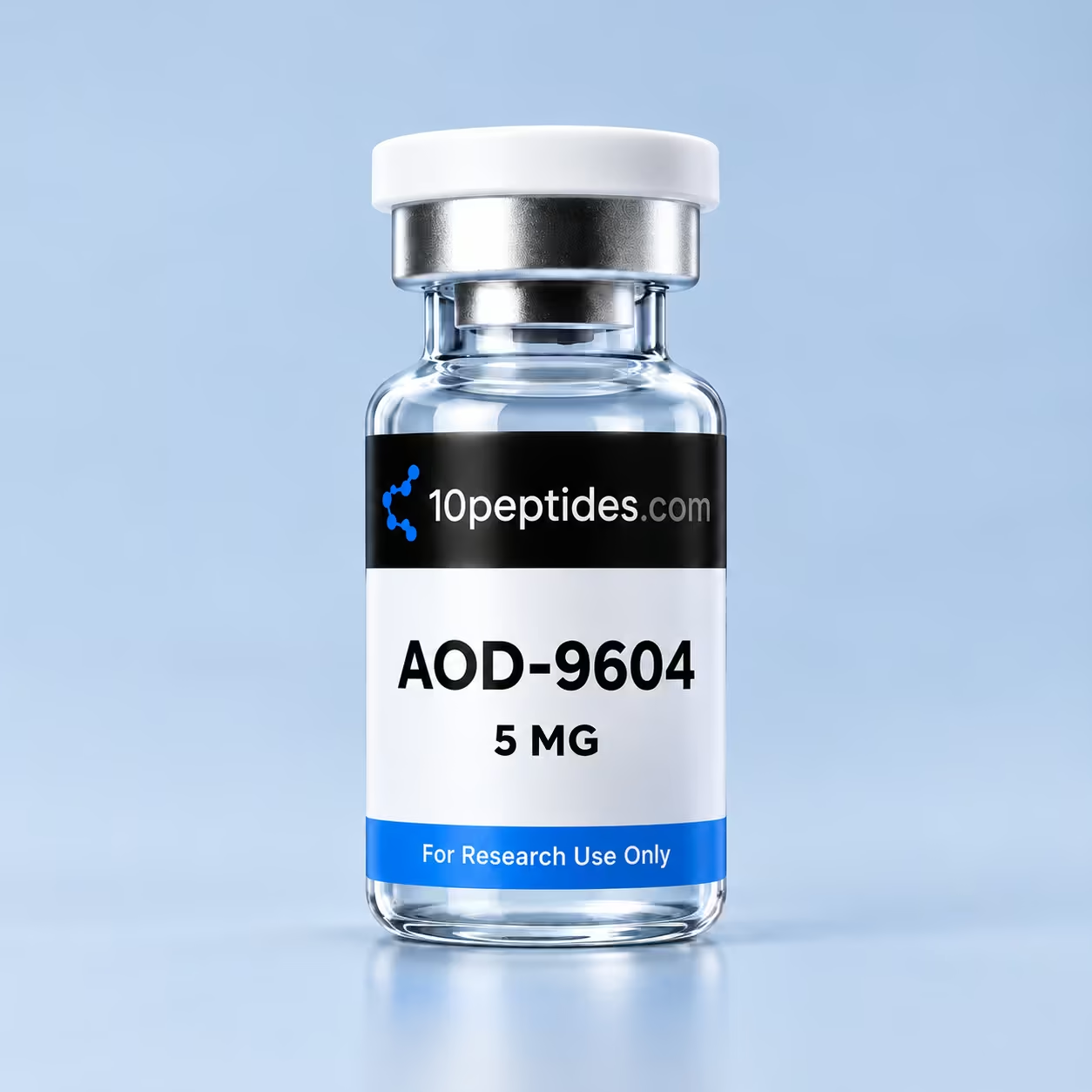
AOD 9604

Price range: $29.00 through $199.00

AOD-9604 is a synthetic peptide fragment derived from the growth hormone sequence, supplied strictly for laboratory and preclinical investigation. It is used in controlled research environments to explore intracellular metabolic signaling, enzyme interaction pathways, and peptide-driven biochemical modulation. As a highly purified and analytically verified compound, AOD-9604 provides researchers with a reproducible peptide model for studying molecular signaling behavior under in vitro conditions. For Research Use Only (RUO).

Earn up to 199 points.
SKU: N/A Category:

Description

“These Statements Have Not Been Evaluated By The Food And Drug Administration.
This Product Is Not Intended To Diagnose, Treat, Cure Or Prevent Any Disease.”


AOD 9604 – Synthetic Peptide Fragment

PRODUCT SPECIFICATIONS

  • Chemical Name: L-tyrosyl-L-leucyl-L-arginyl-L-isoleucyl-L-valyl-L-glutaminyl-L-cysteinyl-L-arginyl-L-seryl-L -valyl-L-alpha-glutamyl-glycyl-L-seryl-L-cysteinyl-glycyl-L-phenylalanine cyclic (7→14)-disulfide.
  • Chemical structure diagram of the AOD 9604 peptide showing labeled amino acids.
  • Peptide Classification: Synthetic growth-hormone–derived peptide fragment
  • Peptide Type: Short-chain bioactive research peptide
  • Molecular Weight: ~1814 Da (reported in literature)
  • Purity: ≥99% (HPLC verified)
  • Solubility: Soluble in sterile water and phosphate-buffered saline (PBS)
  • Storage: −20 °C, protected from light and moisture
  • Molecular Structure: AOD 9604 is a modified peptide fragment derived from growth hormone sequence research, engineered for enhanced structural stability and reproducible laboratory behavior.
  • Disclaimer: For Research Use Only (RUO). Not for human or veterinary use.

MAIN DESCRIPTION

AOD 9604 is a synthetic growth-hormone–derived peptide fragment developed through rational peptide design to enhance molecular stability, enzymatic resistance, and laboratory reproducibility. Unlike full-length peptide hormones, AOD 9604 is engineered as a targeted research fragment to allow focused investigation of metabolic signaling mechanisms at the cellular level.

In biochemical research environments, AOD 9604 serves as a reference peptide model for pathway mapping, enzyme-regulated signal transduction, and intracellular metabolic simulation studies. Its predictable structural integrity and analytical consistency allow cross-laboratory replication and comparative peptide research.

EXPERIMENTAL & ANALYTICAL USE

AOD 9604 is used in laboratory research for:

  • Mapping peptide–enzyme interaction pathways using in vitro assay platforms
  • Studying intracellular metabolic signal modulation
  • Evaluating structure–activity relationships (SAR) across synthetic peptide analogs
  • Supporting biochemical modeling of enzyme-regulated pathways
  • Comparative peptide framework analysis within metabolic signaling research

In these settings, AOD 9604 often serves as a reference peptide compound for benchmarking synthetic fragments across multi-peptide research systems.

Toxicology and Detection Methods

For toxicology and anti-doping research, AOD-9604 is detected in biological matrices using Liquid Chromatography-Tandem Mass Spectrometry (LC-MS/MS).

Urinary Metabolite: The primary stable metabolite identified in urine is the sequence CRSVEGSCG, formed by the proteolytic cleavage of the N-terminal and C-terminal residues.

Detection Window: Methods utilizing solid-phase extraction (SPE) validated by Wiley have established a limit of detection (LOD) of 50 pg/mL, allowing for identification in urine samples for several days post-administration.

These analytical methods are used exclusively for forensic, anti-doping, and laboratory toxicology research and do not imply pharmacological application

Handling and Stability

AOD-9604 is typically supplied as a lyophilized white powder (acetate salt).

Solubility: It is slightly soluble in DMSO and water. Reconstitution often requires pH adjustment or the use of mild acetic acid to ensure full dissolution of the acetate salt form.

Storage: Lyophilized peptide is stable at -20°C. Once reconstituted, the presence of the disulfide bridge makes the solution sensitive to freeze-thaw cycles; aliquoting is recommended.

3D molecular structure of AOD-9604 (Tyr-hGH Frag 177-191) showing the cyclic disulfide bridge between Cys7 and Cys14. The ball-and-stick model represents the hexadecapeptide sequence C78H123N23O23S2 in a sterile laboratory setting, labeled for Research Use Only to distinguish from therapeutic products.

MOLECULAR & TECHNICAL CHARACTERISTICS

AOD-9604 is synthesized under high-purity (≥99%) HPLC-verified conditions, ensuring:

  • Structural consistency
  • Elimination of peptide chain truncation
  • High aqueous solubility in standard buffers
  • Stability during repeated analytical testing

When stored at −20 °C and protected from light and moisture, AOD-9604 retains its chemical integrity and laboratory performance stability, making it suitable for long-term research programs and cross-lab validation studies.

SCIENTIFIC SIGNIFICANCE

The study of AOD-9604 contributes to the broader understanding of:

  • Peptide-regulated metabolic signaling
  • Intracellular enzyme-driven modulation
  • Synthetic peptide structure–function relationships
  • Biochemical pathway modeling in preclinical research

By offering a chemically stable, reproducible, and ethically deployable peptide model, AOD 9604 enables researchers to investigate complex metabolic signaling behavior at the molecular level.

RUO COMPLIANCE

All experimental applications of AOD 9604 are conducted under Research Use Only (RUO) protocols.

It is not intended for human or veterinary use, nor for diagnostic or therapeutic purposes. All information is derived from peer-reviewed scientific literature and provided strictly for academic and laboratory reference.

FEATURES / HIGHLIGHTS

  1. Synthetic growth-hormone–derived peptide fragment for metabolic signaling research
  2. Supports intracellular enzyme-pathway investigation
  3. Enables preclinical metabolic modeling under in vitro conditions
  4. Verified ≥99% purity (HPLC-tested)
  5. High solubility and long-term stability at −20 °C
  6. Designed and certified for Research Use Only (RUO)

Additional information

options

2 mg vial, 2 mg vial with AA water and Bacteriostatic water, wholesale set of 10 vials 2 mg each