Sale!

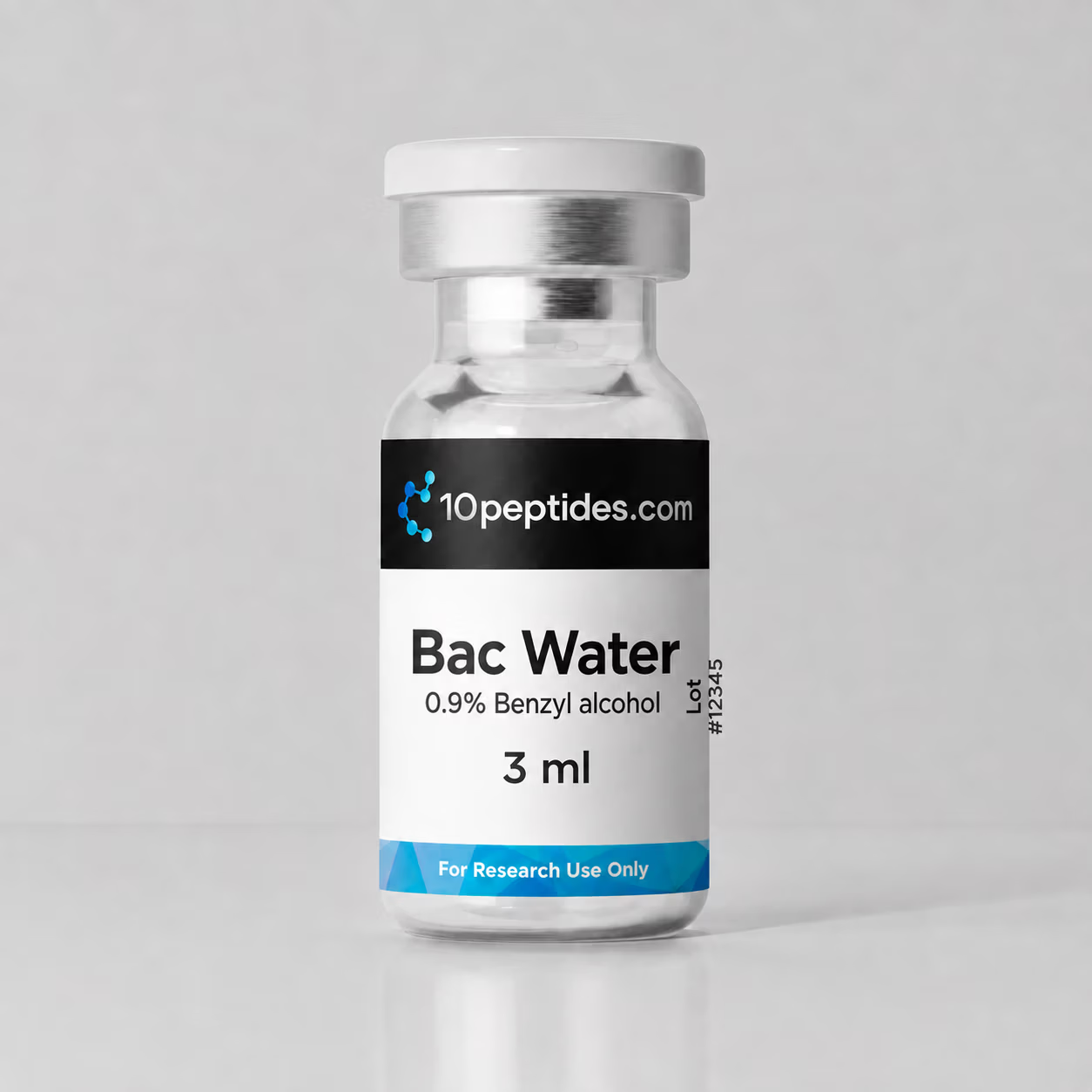
Bacteriostatic Water (Bac Water)

Price range: $7.99 through $499.00

Premium Bacteriostatic water, designed for reconstitution and preservation of lyophilized research compounds, peptides, and proteins for laboratory study.


⚠ Product Usage: For Research Use Only – Not for Human or Veterinary Use

10peptides products are supplied to qualified research professionals and institutional users for in vitro laboratory research only. KYC verification is required prior to order fulfillment, and we reserve the right to refuse orders that do not meet buyer qualification criteria. These products are not drugs, foods, cosmetics, or dietary supplements, have not been evaluated by the FDA, and are not intended for human or animal use. Any such use is prohibited and may violate federal, state, or local law. By purchasing, the buyer represents and warrants that the product will be used solely for in vitro research.

Technical Specifications

Molecular Data
Product Ref
Bacteriostatic water
CAS Number
7732-18-5
Chemical Class
Aqueous Solution
Molecular Weight
18.02 g/mol (Water)
Sequence Length
Not applicable
Format
3 ml and 10 ml vials
Mass Format
N/A (Liquid Solution)
Purity
Greater than 99%
Solubility
Completely miscible with water
Storage
Store at controlled room temperature (20–25°C / 68–77°F). Protect from excessive heat and freezing.
Intended Use
Intended exclusively for laboratory and in vitro research applications.

Product Description

Discovery and Scientific Background

This product comprises a multi-draw sterile diluent known as Bacteriostatic Water. It is classified as an antimicrobial solvent, combining highly purified laboratory water with a 0.9% concentration of benzyl alcohol.

Unlike single-use sterile water that lacks preservatives and must be discarded immediately after opening, Bac Water’s multi-draw architecture enables researchers to maintain the sterility of their stock solutions over multiple experimental sessions. This makes it uniquely valuable for longitudinal cell-culture studies, stable research compound reconstitution, and comprehensive preclinical testing design.

Laboratory Applications

In 2026-era preclinical research, this compound is utilized to study and prepare:

Reagent & Protein Reconstitution: Rehydrating lyophilized synthetic compounds (such as research-grade aminos) to create stable, sterile stock solutions for cell-based assays and analytical testing.

Micro-Volume Aliquot Preparation: Utilizing the benzyl alcohol preservative to allow a single sealed receptacle to be accessed repeatedly over 28 days, reducing reagent waste and ensuring consistent laboratory dilutions. Analytical Test Vehicles: Providing a controlled, preserved aqueous vehicle for diluting research compounds before ex vivo tissue studies or in vitro cellular modeling.

Instrument & Reagent Rinsing: Maintaining sterile conditions in the laboratory by using the bacteriostatic solution to rinse pipettes or analytical instruments used to handle highly sensitive compounds.

Preservative Interaction Assays: Studying the interaction of 0.9% benzyl alcohol on the half-life and stability of various synthetic amino-acid sequences in aqueous environments.

MOLECULAR STRUCTURE

Benzyl Alcohol (Active Preservative in Bac Water)

PubChem CID 244 (Water: CID 962)

Benzyl alcohol chemical structure used as a preservative in Bac Water

Water molecule structure showing H₂O used as a solvent in Bac Water


Benzyl Alcohol (used in Bac Water) PubChem ID: 244
Water (used as a solvent in Bac Water) PubChem ID: 962


Bacteriostatic water is a two-component system: purified water (H2O) and a 0.9% concentration of benzyl alcohol (C7H8O). Benzyl alcohol features an aromatic benzene ring attached to a methylene group bearing a hydroxyl substituent. This specific molecular structure provides the bacteriostatic properties, actively inhibiting the reproduction of bacteria and ensuring the extended 28-day viability of the multi-draw container.

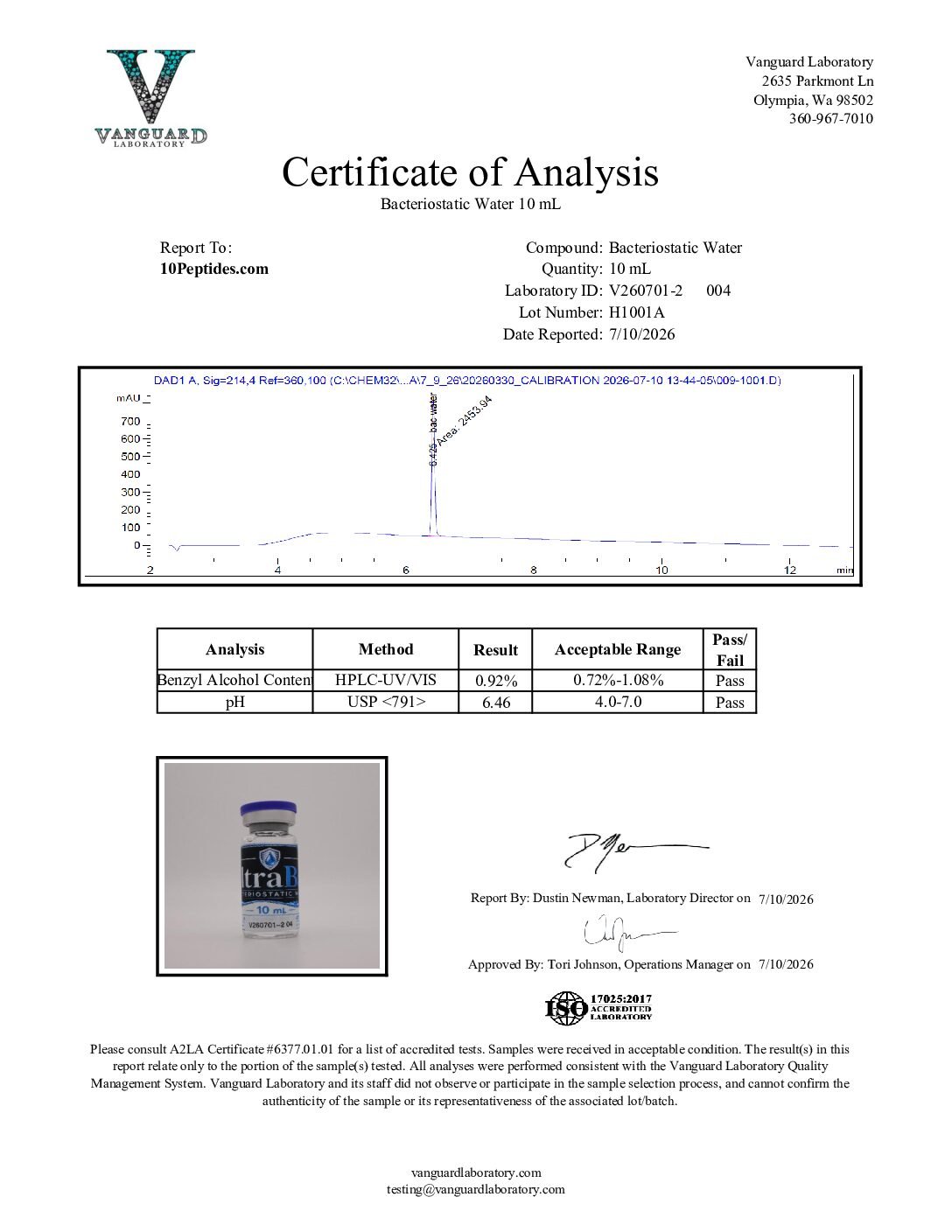
Certificate of Analysis

At 10Peptides, transparency is key. Every batch is third-party tested in the USA, with Certificates of Analysis (COAs) readily available for verification, giving researchers confidence in their work.

FAQ

What is Bacteriostatic Water?

Bacteriostatic Water is sterile USP-grade water containing 0.9% benzyl alcohol as a bacteriostatic preservative. It is commonly used in laboratory settings to dissolve or dilute powdered research compounds so they can be sampled multiple times from the same vial. The preservative helps inhibit bacterial growth after the vial has been opened, making it suitable for repeated laboratory use when handled according to established research protocols.


What is the difference between Bac Water and standard Sterile Water?

The critical difference is the presence of the preservative. Bacteriostatic water contains 0.9% benzyl alcohol, enabling multi-use over a 28-day period. Standard sterile water contains zero preservatives and must be discarded immediately after a single use to prevent bacterial contamination.


How long does Bac Water last after the first puncture?

When handled using strict aseptic techniques in a sterile laboratory environment, the 0.9% benzyl alcohol preservative maintains the integrity of the solution for up to 28 days after the initial entry.


Can Bac Water be used outside a controlled laboratory research setting?

Absolutely not. This compound is classified strictly for laboratory investigation only. Any non-laboratory use—including personal, consumer, or wellness applications—violates our Terms of Service and will result in immediate order cancellation.


IMPORTANT LEGAL NOTICE
PLEASE READ!

The products on this website are for legitimate research use only. They are not intended to prevent, treat, or cure any illness or disease and are not intended for human consumption. By accessing this site, you acknowledge that you are at least 18 years of age, understand these terms, and have a legitimate research basis for buying these products


NOTE: All of our compounds are sold individually, and DO NOT include research supplies such as syringes. Most are sold in powder form and require reconstitution with a suitable diluent solution prior to research.

0